Two Audiences, One Resume: Winning Over the Bot and the 7-Second Human Scan
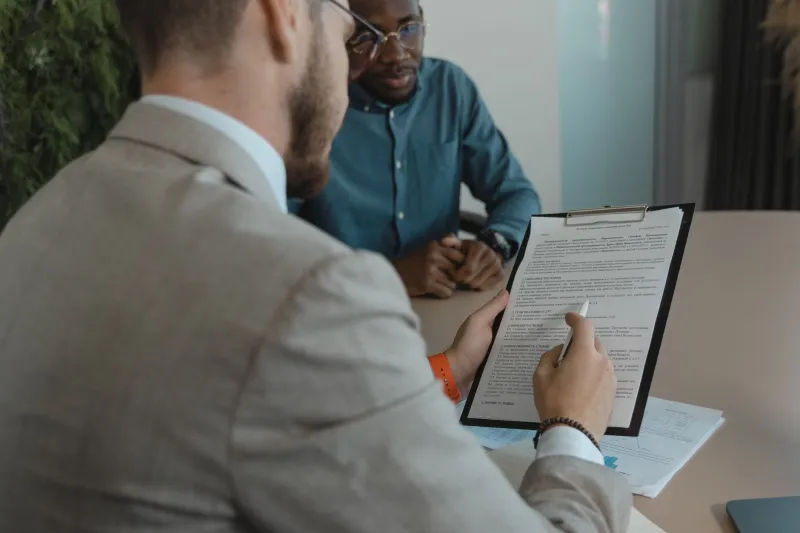
Here's an uncomfortable truth about job hunting in America right now: your resume gets read twice before anyone decides anything. First by software. Then — if it survives — by a human who spends about as much time on it as a TikTok video.
Most resumes are built for neither reader. They're built for the applicant's ego. Let's fix that.
Reader #1: The Algorithm
Roughly 97% of Fortune 500 companies use an applicant tracking system, and plenty of mid-size companies do too. The ATS doesn't read your resume the way you think it does. It parses, it matches, it scores. It's looking for:
- Keywords pulled from the job description
- Recognizable section headers
- Clean, linear structure it can parse without choking
This is the gatekeeper. Fail here and no human ever knows you existed.
What the bot needs from you:
- Exact-match language. If the posting says "budget forecasting," don't write "financial planning."
- Standard headers: Summary, Skills, Work Experience, Education.
- One column, no text boxes, no graphics, no tables.
- Job titles, company names, and dates in plain text — not buried in a design element.
Get this right and you've earned your seven seconds with a human. Now the real test begins.
Reader #2: The Seven-Second Human
Recruiters are busy people. Ladders' famous eye-tracking study found recruiters spend an average of about 7.4 seconds on an initial resume scan. In that window, they're not reading — they're pattern-matching. Here's the hierarchy of what their eyes actually hit, in order:
1. Your current title and company
The first thing a recruiter wants to know: what are you now, and where? If your most recent role is buried below a wall of summary text, you've already lost. Your current title should be impossible to miss in the top third of page one.
2. The dates
Recruiters scan dates to check for gaps and job-hopping before they read a single bullet. Don't make them hunt. Use a consistent format — "Mar 2021 – Jun 2023" — right-aligned or immediately after the company name. Unexplained gaps invite assumptions; a two-line explanation beats a mystery every time.
3. Your most recent role's bullets
Nobody reads your 2015 internship first. The top bullet of your current job gets more attention than everything else combined. Lead it with your strongest, most quantified accomplishment — not a list of responsibilities.
Weak opener:
Responsible for managing the social media calendar
Strong opener:
Scaled TikTok and Instagram channels from 8K to 120K followers in 14 months, cutting cost-per-lead by 38%
4. Metrics
Numbers stop the eye. Percentages, dollar figures, team sizes, timeframes — they're proof in a sea of claims. Aim for at least one metric in every recent role.
5. Education and extras (barely)
Unless you're a recent grad or applying to a role where credentials are non-negotiable, education is a footer, not a feature.
Structuring for Both Readers at Once
The good news: optimizing for the bot and the human isn't a trade-off. It's a sequence.
Top of page one (the hook): Name, contact info in the body, target title that mirrors the posting, and a two-to-three-line summary stuffed with your top keywords. This satisfies the ATS and gives the recruiter an instant "this person does what we need" read.
Middle (the proof): Reverse-chronological work experience. Job title, company, dates — all machine-readable. Three to five bullets per role, each starting with an action verb and landing on a number where possible. Your current role gets the most bullets; older roles get fewer.
Bottom (the formality): Skills listed as plain text (great for keyword matching), then education, then anything optional.
The Test That Takes 90 Seconds
Before you submit, run this gut-check: open your resume, look at it for seven seconds, then look away. What do you remember?
If the answer is "a title that matches the job, recent dates that make sense, and a big number," you've passed the human test. Then paste the resume into a free ATS scanner and check your keyword match against the posting. If both pass, hit send.
Your resume isn't a biography. It's a two-stage rocket: the ATS gets you off the ground, and the seven-second scan gets you into orbit. Build for both, or watch your applications stall on the pad.